
/ Blog
How we got here: a brief history of paying for things on the internet
1994: Pay upfront or go home
You bought software in a box. One payment, one CD-ROM.
Microsoft sold Windows for $209.
Netscape Navigator launched in December 1994 as one of the first commercial web browsers.
If you wanted quality software, you paid a license fee. No trial. No refund.
2000: The ad model
Google launched AdWords in October 2000 and figured out something clever.
Give the product away for free, sell the user's attention instead.
The first web banner ad had already appeared in 1994 (HotWired sold one to AT&T), but Google industrialized it.
Search, email, social, maps... all "free."
The cost? Your data, your privacy, and an internet drowning in ads.
2006: Freemium
The term was coined this year, and the model exploded.
Spotify (2008), Dropbox (2008), and later Slack (2013) proved you could give a basic version for free and charge for premium features.
Better than ads, sure.
But it created a world where 95% of users never pay and the 5% who do subsidize everyone else.
2007: Subscriptions take over
Netflix launched streaming in 2007.
Adobe followed with Creative Cloud in 2013.
Eventually every SaaS company switched to monthly billing.
Predictable revenue for companies.
Subscription fatigue for everyone else.
2006–2011: The API economy
AWS launched in 2006, Twilio in 2008, Stripe in 2011.
They built the developer economy on pay-per-use APIs.
Powerful stuff.
But every integration requires an account, API keys, a credit card on file, and weeks of onboarding.
2024: AI agents arrive
Large language models start doing real work.
Browsing, researching, buying, executing.
But here's the problem: agents can't fill out a credit card form.
They can't sign up for an account.
They can't subscribe.
Every existing payment model was designed for humans clicking buttons.
2025: x402
Coinbase builds a protocol that turns HTTP 402 Payment Required (a status code that existed since 1997 but was never used) into a real payment rail.
An AI agent hits a paid API, gets a price, pays instantly in USDC, and gets the result.
No forms, no accounts, no human in the loop.
- Official site: x402.org
- Coinbase announcement: Introducing x402
- GitHub: x402-foundation/x402
Today, June 2026
The x402 protocol is an open standard under the Linux Foundation.
Coinbase and AWS are founding members.
The numbers?
75M+ transactions and $24M+ in volume in the last 30 days.
Roughly a quarter of the internet (everything on AWS CloudFront) can now accept payments from AI agents.
→ Coinbase and AWS let publishers accept agents as customers via x402
The internet finally has a native payment layer.
BlockVault is the wallet that puts it in your pocket
What is BlockVault?
BlockVault is a crypto wallet where you own your keys, manage 14 blockchains from one place, and have an AI assistant that can check your portfolio, send transactions, and pay for services on your behalf.
All from your phone.
All private.
- Official website: blockvault.ai
- Follow: @blockvaultapp
What makes BlockVault different?
Most wallets let you send and receive. That's it.
BlockVault gives you an AI assistant that actually understands crypto.
It can check your balances across every chain, help you plan investments, browse decentralized apps, and pay for things. All in one conversation.
You tell it what you want.
It figures out the how.
You approve.
How it works
Your keys stay on your device
BlockVault uses the same encryption standards trusted by banks and governments.
Your recovery phrase is encrypted and stored in your phone's secure hardware.
That's the same chip that protects your Face ID and fingerprint data.
No server ever sees your keys. Not even ours.
You log in with your fingerprint or face.
No emails, no passwords, no accounts to get hacked.
14 blockchains, one recovery phrase
Bitcoin, Ethereum, Solana, Polygon, Base, Arbitrum, Optimism, BSC, Counterparty, Tempo, dYdX, Osmosis, and Noble.
One recovery phrase gives you access to all of them.
No need to install five different apps or manage five different backups.
An AI assistant that actually does things
This is the big one.
BlockVault has a built-in AI assistant powered by LangGraph (@LangChain), the same agent technology used in production by Klarna, LinkedIn, Elastic, Uber, and ServiceNow.
We brought it to a mobile wallet.
Three ways to run it:
On your phone: the AI runs entirely on your device. No internet needed. Your data never leaves your phone.
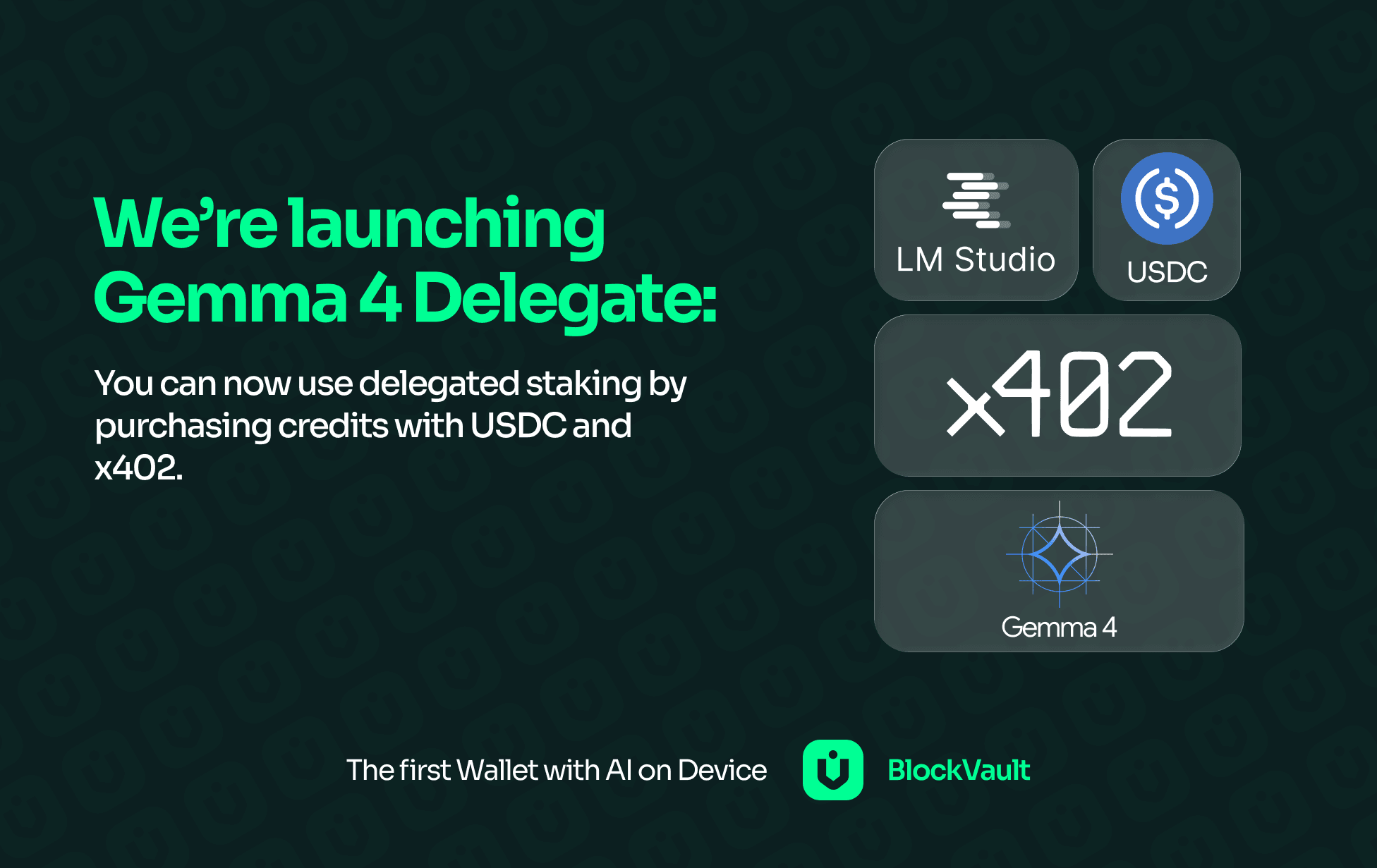
(@googlegemma + LiteRT)On your home server: connect to your own AI model running on your network.
(LM Studio – @lmstudio)In the cloud: authenticated with your wallet. No accounts or passwords needed.
What can it do?
A lot.
- “What's my portfolio worth right now?” → It checks all 14 chains and gives you a total.
- “Send 0.5 ETH to this address.” → It builds the transaction, you approve, it sends.
- “Help me plan a DCA strategy for Bitcoin.” → It calculates entry points and tracks your schedule.
- “What's happening in crypto today?” → It searches the web and gives you a summary.
- “Buy a $50 Amazon gift card.” → It finds the best rate on Bitrefill and pays with your crypto.
It remembers your previous conversations.
It gets better the more you use it.
Skills: teach your AI new tricks
The AI assistant learns new abilities through Skills.
Small add-ons you can install from GitHub.
Think of them like apps for your AI.
Some examples:
- Portfolio Analyst: breaks down your holdings and suggests rebalancing
- Paper Trading: practice trading strategies without risking real money
- Trip Planner: plan a trip with interactive maps, pay with crypto
- Bitrefill: buy gift cards and phone top-ups with your balance
- Crypto News: get a daily market briefing
- Stock Market Analyst: track tokenized stocks
Anyone can create a skill.
Your AI picks them up automatically.
No app update needed.
Browse any dApp without leaving the wallet
BlockVault has a built-in web browser for decentralized apps.
Connect to Uniswap, Aave, or any dApp across five different blockchain ecosystems at the same time.
No browser extensions.
No extra apps.
Just open, connect, and use.
Your AI can pay for things (x402)
This is where it gets interesting.
The internet has always had a code for "you need to pay for this": HTTP 402.
It's been there since the beginning, but nobody ever used it.
Now, the x402 protocol makes it real.
In June 2026, Coinbase and AWS announced that roughly a quarter of the internet can now accept payments from AI agents through x402.
Nishit Sawhney (@nsawhney), GM of AWS Edge Services:
“That changes the conversation from defence to commerce.”
Brian Foster (@brian__foster), Head of Infrastructure Growth at Coinbase:
“Any publisher can start earning from that growing activity today.”
In BlockVault, this works simply:
- Your AI requests something from a paid service
- The service says “this costs $0.05”
- BlockVault shows you a quick approval
- You tap yes. Payment happens instantly in USDC.
- You get the result
No credit cards, no sign-ups, no forms.
Your AI handles it.
Getting started
Step 1: Download BlockVault. Create your wallet in 30 seconds. Set up fingerprint login.
→ Get it here and claim your 50 BLVC bonus
→ Or visit blockvault.ai
Step 2: Ask the AI: “What's my portfolio worth?”
It checks every chain and gives you a number.
Step 3: “Help me invest $50/week in ETH.”
The AI sets up a plan for you.
Step 4: Browse DeFi apps, earn yield, explore tokenized real-world assets on a map.
Let your AI keep an eye on everything.
Ongoing: Install new skills as they come out.
Your AI learns new abilities without app updates.
For businesses: reach users through their AI
Coinbase launched “Coinbase for Agents” in June 2026.
Their take:
People are increasingly moving through the world via agents rather than apps.
BlockVault is built for that shift.
If you run a business, there are two ways to reach BlockVault users:
1. Create a Skill
Write a simple instruction file and put it on GitHub.
BlockVault's AI reads it and offers your service to users when it's relevant.
| What you sell | What the user says | What happens |
|---|---|---|
| Gift cards (Bitrefill) | “Get me a $50 Amazon card” | AI finds the best rate, you pay with crypto |
| Staking (Stakely) | “Stake my SOL” | AI compares options and executes |
| Shopping (Rye) | “Order running shoes” | AI browses, you approve, crypto pays |
| Exchange (Bit2me) | “Buy 0.1 BTC” | AI handles the purchase flow |
No app to build.
No SDK to integrate.
A skill takes hours to create, not months.
2. Put your API behind x402
The x402 ecosystem is growing fast.
Coinbase runs Agentic Market, a directory of x402-enabled services.
The x402 Bazaar is the open version where any service can be discovered by AI agents worldwide.
Set a price on your API.
When someone's AI needs your data, it pays automatically in USDC.
You get paid instantly.
No invoices, no payment processors, no chargebacks.
Why this works
- Ship in hours, not months
- Every BlockVault user is a potential customer
- Get paid in USDC, on-chain, instantly
- Users discover you through conversation, not app stores
The internet is moving from apps to AI agents.
Coinbase and AWS are building the payment rails.
The x402 protocol is already processing 75M+ transactions a month.
BlockVault puts all of that in your pocket.
Your keys. Your AI. Your privacy.
For users: one wallet, one assistant, every chain.
For businesses: publish a skill, get paid in USDC, ship in hours.
Your keys. Your AI. Your financial freedom.
BlockVault is open for early adopters.
Follow @blockvaultapp for updates.
/ Get started
Try BlockVault — the AI wallet that runs on your device.